
M. Chad Bolding  ,
Joseph L Conrad IV,
Natascia Magagnotti,
Raffaele Spinelli,
Timothy R Miller
,
Joseph L Conrad IV,
Natascia Magagnotti,
Raffaele Spinelli,
Timothy R Miller
Productivity and cost of cut-to-length harvesting on small wet sites in the US South
Bolding M. C., Conrad IV J. L., Magagnotti N., Spinelli R., Miller T. R. (2026). Productivity and cost of cut-to-length harvesting on small wet sites in the US South. Silva Fennica vol. 60 no. 2 article id 26004. https://doi.org/10.14214/sf.26004
Highlights
- Harvester productivity was most impacted by tree size and species
- Wet site conditions and scattered logs reduced forwarder productivity
- Adding a mobile loader or using setout trailers could significantly improve system productivity and reduce costs.
Abstract
The cut-to-length (CTL) harvesting system is utilized globally in diverse forest types, prescriptions, and terrain conditions. Despite this versatility, the system is used sparingly in the US South, which predominantly uses full-tree (FT) systems. The region also contains forested areas characterized as wet mineral flats with hydric soils ranging from sandy loams and fine sands to mucky fine sands. Wet site harvesting is challenging for FT wheeled machines; therefore, these sites are often harvested with shovel logging systems (SL) utilizing tracked excavators and large wheeled skidders. Due to high logging costs, SL requires large sites and timber volumes for economic feasibility. Wet sites that are too small for cost-effective SL and too wet for FT machines often go unmanaged. Due to value recovery potential, low ground pressure, and trafficability in wet conditions, we evaluated the use of a CTL system on small wet sites (<15 ha). Time-and-motion studies were conducted on a Ponsse Ergo harvester and Elephant forwarder while felling-processing, forwarding, and loading. Studies determined productivity and cost for each machine and evaluated opportunities for improvement. Onboard truck costs averaged $15.91 m–3. Adding a mobile tracked loader to load trucks would increase system productivity by 53% and reduce onboard truck costs by $1.71 m–3. Alternatively, adding setout trailers would increase system productivity by 32% and reduce onboard truck costs by $2.92 m–3. Our results provide information on an alternative harvesting system for harvesting small, wet sites. With modifications, the CTL system can be cost effective to recover timber often unutilized.
Keywords
forwarder;
cost;
harvester
-
Bolding,
Harley Langdale Jr. Center for Forest Business, Warnell School of Forestry and Natural Resources, University of Georgia, Athens, Georgia, USA
 https://orcid.org/0000-0002-6212-7133
E-mail
bolding@uga.edu
https://orcid.org/0000-0002-6212-7133
E-mail
bolding@uga.edu
- Conrad IV, Harley Langdale Jr. Center for Forest Business, Warnell School of Forestry and Natural Resources, University of Georgia, Athens, Georgia, USA E-mail jlconrad@uga.edu
- Magagnotti, Consiglio Nazionale delle Ricerche, Istituto per la Bioeconomia (CNR IBE), Firenze, Italy E-mail natascia.magagnotti@cnr.it
-
Spinelli,
Consiglio Nazionale delle Ricerche, Istituto per la Bioeconomia (CNR IBE), Firenze, Italy
https://orcid.org/0000-0001-9545-1004
E-mail
raffaele.spinelli@cnr.it
-
Miller,
Harley Langdale Jr. Center for Forest Business, Warnell School of Forestry and Natural Resources, University of Georgia, Athens, Georgia, USA
https://orcid.org/0009-0005-5499-3073
E-mail
timothy.miller@uga.edu
Received 24 January 2026 Accepted 6 June 2026 Published 18 June 2026
Views 16527
Available at https://doi.org/10.14214/sf.26004 | Download PDF

Supplementary Files
1 Introduction
Forest harvesting consists of changing the state and position of trees, that is: from standing trees in the forest to logs piled at the roadside, ready for transportation to processing facilities. In full-tree (FT) harvesting, trees are felled and moved to the roadside where they are converted into logs. In cut-to-length (CTL) harvesting, trees are converted into logs at the felling site and then transported to the roadside (Lindroos et al. 2017; Erler et al. 2024).
FT harvesting offers simplified in-forest handling, maximized biomass recovery, and thorough field cleaning, which can be advantageous in fertile stands where the removal of nutrients in logging residues does not jeopardize future productivity and/or the soil needs to be prepared for the next crop (Kammenga 1983). CTL harvesting takes a different approach, in which stems are felled and processed at the stump and transported to roadside as logs using a forwarder, which minimizes residual stand damage compared to skidding (Lanford and Stokes 1995; Han and Kellogg 2000; Koŝir 2008). In addition, stump-site processing results in lower organic matter removals, since limbs, tops, and offcuts are left in the forest. This is especially desirable on poor sites, where organic soil fertility may represent a limiting factor to tree growth (Jacobson et al. 2000; Nord-Larsen 2002; Smolander et al. 2010).
CTL is common in Europe, where mechanized CTL harvesting accounts for 60% of the total volume produced, or 230 million m3 per year (Lundbäck et al. 2021). That proportion grows to over 90% of the total in the Nordic countries (i.e., Finland, Sweden), where the CTL system was originally conceived and where some of the largest manufacturers of CTL equipment are located. On the other hand, mechanized FT harvesting dominates in North America, where it accounts for 2/3 of the annual harvest, or 340 million m3 (Lundbäck et al. 2021). This difference likely reflects variation in terrain conditions, economic environment, and tradition (Di Fulvio et al. 2024; Bolding et al. 2025). The two harvesting systems adapt differently to terrain characteristics, tree and woodlot size, silvicultural regime and markets (Ghaffariyan 2014). For instance, CTL harvesting has proven successful in thinning operations with multiple product assortments, due to the better handling quality of short logs, the potential for increased value recovery and the lower residual stand damage: those are some of the reasons why it is favored in Europe (Harstela 1999). Based on fewer and smaller machines, CTL harvesting becomes more competitive as woodlot size decreases and fuel prices increase (Zhang et al. 2016). Conversely, FT harvesting is best suited to mass handling, and its performance is more resilient to variations in tree size, compared with CTL (Gingras 2004; Spinelli et al. 2009). CTL equipment can be adapted for multi-tree handling (Magagnotti et al. 2021); however, they were originally designed for handling one tree at a time and may experience reductions in product quality when handling more than one tree per cycle (Erber et al. 2016).
The prevalent work conditions in a region will inevitably favor the dominance of one or the other system, and yet there is often benefit in diversification, as that increases the resilience of any system: biological (Pimentel et al. 1997), financial (Viceira and Wang 2018), or social (Roberge and Van Dick 2010). A diversity of available harvesting systems allows forest managers to tailor silvicultural and harvest prescriptions to site and market conditions. The US forest industry is diverse, and its characteristics vary considerably by geographic region. The usage of CTL in the Lake States and Northeast regions has increased over time (Shivan et al. 2020; Bailey and Crawley 2023), but this trend has not emerged in the US South, where CTL accounts for less than five percent of annual harvest volume (Barrett et al. 2017; Conrad et al. 2024; Bolding et al. 2025; Khadka et al. 2025). Harvesting in that region is predominantly conducted with FT systems utilizing wheeled or tracked feller-bunchers, grapple skidders, and tracked or trailer-mounted loaders. Even so, mechanized CTL technology has had a presence in the region since its first appearance in the international markets (Lanford 1982). Over the years, repeated attempts have been made to find a sweet spot for CTL, alongside the dominant FT harvesting. Most such attempts sought to capitalize on CTL’s trafficability advantages on challenging terrain and sensitive soils (McDonald and Seixas 1997) while focusing on partial harvests, especially thinning operations (Kellogg and Bettinger 1994; Tufts 1997). However, thinning implies handling small stems and imposes a severe handicap to a single-tree technology such as CTL (Holtzscher and Lanford 1997). Once properly organized and managed (Visser and Stampfer 2003), FT can offer an equally good thinning job at a lower cost (Adebayo et al. 2007). Other studies have evaluated the potential of CTL harvesting for increasing value recovery in typical pine plantations of the US South due to the use of computer-aided bucking. Conradie et al. (2004) found that CTL harvesters were able to recover 90–94% of total stem value. However, these promising results are typically offset by the complexity of the machines and the lack of trained CTL operators (Boston and Murphy 2003).
Improved trafficability and value recovery are only two of the 27 potential benefits of CTL harvesting listed by southeastern operators (Conradie 2003). A prominent place in the list is rightly taken by the need for only two machines in the CTL system and the resulting lower relocation cost, which makes CTL a prospective solution for small tracts, a growing component of the loggers’ harvests in many areas (Moldenhauer and Bolding 2009). Further, the relative larger presence of CTL operations in the US Northeast (Huyler and Ledoux 1999) and Lake States (Shivan et al. 2020) might be related to an earlier trend towards parcelization in those regions (Kittredge et al. 1996).
The lower Coastal Plain physiographic region of the US South has extensive areas classified as wet mineral flats with hydric soil conditions and common textures ranging from sandy loams and fine sands to mucky fine sands (Aust et al. 2020; USDA NRCS 2025). These conditions present a significant operational challenge for FT systems using wheeled equipment due to limited soil bearing capacity that hinders machine mobility and increases the risk of site damage. As a result, harvesting is often conducted with shovel logging (SL) systems using large, tracked excavators for felling and large wheeled skidders for extraction. SL systems typically require large harvest areas and substantial timber volumes to be economically viable due to high harvesting costs resulting from increased harvest planning and the construction of corduroy roads due to the trafficability limits imposed by wet terrain (Stokes and Schilling 1997; Aust et al. 2020). The extraction trail network must be carefully designed and prepared, to avoid production losses and undesirable site impact. That incurs a significant fixed cost, which can erode the financial viability of small tracts. As a result, small wet sites that are too wet for FT systems and too small for SL systems are frequently left unmanaged. As a two-machine system, CTL is easier to relocate and requires less preparatory work, which can make it a possible solution for such conditions. In addition, CTL machines have lower ground pressure than FT machines and travel on slash mats (McDonald and Seixas 1997). As a result, they may be able to operate on some wet sites without excessive rutting demonstrated by Sirén et al. (2019), reducing the need to construct corduroy roads. Corduroy roads are characteristic of FT SL in the region (Gerow and Lang 2022) and the reduction or elimination of such could result in lower harvesting costs.
Because of the prevalence of FT harvesting systems and mill requirements for recently harvested timber, log trailers are loaded as the timber is harvested rather than being stored on the roadside for later delivery. CTL systems provide multiple options for loading log trailers. Forwarders can load trailers while the truck is on site. This option requires the forwarder operator to spend time completing load tickets and communicating with truck drivers, which reduces forwarder productivity. A second option is for forwarders to directly offload their payload onto spare log trailers (i.e., setout trailers) that will be picked up by a truck hours or days later. This option requires the contractor to invest in additional trailers. The third option involves forwarders offloading their payload onto the landing for loading by a dedicated tracked loader. This option requires the logging business to purchase another piece of equipment and hire another operator. Self-loading trucks are not used in the region because of restrictive weight limits and payload losses associated with the self-loading mechanism.
The goal of this study was to evaluate the performance of a CTL operation using a harvester and forwarder when deployed for harvesting small tracts in wet areas in the US South. In particular, the study was designed to 1) estimate individual machine and system productivity and cost and 2) evaluate system performance, loading strategy, and opportunities for improvement.
2 Materials and methods
The study was conducted in the state of Georgia, USA in the lower Coastal Plain physiographic region. Soils were classified as predominantly Surrency mucky fine sands that are frequently ponded and present a moderate soil rutting hazard (USDA NRCS 2025). Overstory species consisted of mature naturally regenerated loblolly pine (Pinus taeda L.) with mixed bottomland hardwood species in the understory. Data were collected during the clearfell harvesting of two small wet sites in close proximity to each other, which were owned and managed by the same industrial landowner. Site one was 3.2 ha and site two was 14.6 ha in size. Since no significant differences were detected between sites and operational conditions, data were combined into one dataset for further analysis. Site one was harvested in August 2024 and site two was harvested in January 2025. Detailed forest inventories were not feasible because of the timing of operations. The landowner provided compartment-level inventory data that included the stands in the study and nearby stands with similar conditions (Table 1). Our primary interest was the dimensions of the harvested trees, which was collected from the harvester’s onboard computer.
| Table 1. Forest compartment-level inventory data for merchantable trees on the two harvest sites provided by the landowner. | ||||
| QMD a (cm) | Trees ha–1 | Basal area (m2 ha–1) | Tonnes ha–1 | |
| Compartment estimate | 18.2 | 1435 | 37.1 | 208 |
| a QMD = quadratic mean diameter. | ||||
The chosen CTL operation consisted of a Ponsse Ergo harvester and a Ponsse Elephant forwarder. Both machines share the same 8-wheeled platform and are powered by the same 210 kW engine. Given the wet site conditions, both machines were equipped with floatation tracks on all bogies. This CTL team performed all harvesting work, from felling the trees in the forest to loading the log trucks for transportation to the mill. The harvester was operated by the same professional for the duration of the study. The operator had previous experience operating a harvester but less than one year with the company and the machine observed during the study. The forwarder was operated intermittently by two separate drivers, depending on availability. Both were experienced truck drivers who began operating CTL machines only a few months before the study but showed very good skills with their new machine. Before starting the experiment, all operators were informed about the purpose and the methods of the study and asked for consent to participate. They all released their consent and did their best to assist with the trial.
The study consisted of a cycle-level time study following established procedures and nomenclature outlined by Olsen and Kellogg (1983), Björheden and Thompson (1995), and Magagnotti et al. (2013). As such, studies were conducted separately for the three main jobs occurring at the site: felling-processing, forwarding, and loading. The element breakdown was kept to a minimum for meaningful inference, to limit the risk for data collection errors and misunderstanding in the interpretation of results. The harvester cycle consisted of the felling and processing of one tree, while a forwarder cycle consisted of the extraction of one load or the loading of one truck – depending on the job being performed (Table 2). Harvester cycle time was determined with a stopwatch, and all cycle variables were recorded by a researcher on board the harvester. Volume processed per cycle was recorded from the harvester’s onboard computer and was combined with cycle time to calculate productivity in both trees per productive machine hour (pmh) and m3 pmh–1. Productivity expressed per pmh represents delay-free time whereas productivity expressed on a scheduled machine hour (smh) basis represents scheduled time including delays. In addition, multiple linear regression was used to predict felling and processing time per tree (s) as a function of tree volume (m3) and species (hardwood or softwood).
| Table 2. Cycle definitions and variables recorded during the elemental time studies of the harvester and forwarder. | |||
| Machine | Functions | Cycle definition | Variables |
| Harvester | Felling and processing | Began when the last piece (i.e., log) of a processed tree was placed on the ground and ended when the last piece of the next tree was placed on the ground | Cycle time Delay time Pieces tree–1 Volume tree–1 (m3) Species |
| Forwarder | Primary transportation | Began when the empty forwarder exited the landing and ended when the forwarder completed unloading the next load and exited the landing | Cycle time Outhaul time Inhaul time Moving time Loading time Unloading time Delay time Forwarding distance Time spent at each stop Number of grapple loads at each stop Number of logs picked up at each stop |
| Loading | Began when the forwarder contacted the first log to be placed on the trailer and ended when the last log was placed on the trailer | Cycle time Delay time Time spent loading front trailer bay Time spent loading rear trailer bay Hot loading or cold loadinga Number of logs loaded | |
| a Hot loading refers to loading a trailer directly from the forwarder while cold loading refers to loading logs previously stacked on the landing. | |||
Forwarder cycle time was also determined with a stopwatch by a researcher on board the machine, who also noted the type (sawlogs or pulpwood) and number of logs being carried (extraction) or loaded onto a log truck (loading) (Table 2). Forwarding distance was estimated using a separate handheld GPS device, carried by the researcher. To determine forwarder truck loading productivity, truck dockets were recorded, so that each specific load could be tracked and associated to a weight determined by the receiving mill. This procedure provided estimates of mean log size and extraction cycle volumes (e.g., mean log volume x n° of logs in the load). The number of logs per load, loading time, and grapple loads were separated by either hot or cold loading and front or rear truck bunks. Hot loading was denoted when the forwarder transloaded from the forwarder directly into the truck and cold loading was denoted when the forwarder either offloaded to a deck or loaded a truck directly from a deck.
The hourly owning and operating costs of the harvester and forwarder were estimated using the machine rate method (Miyata 1980; Brinker et al. 2002) as updated by Black et al. (2025). An off-highway diesel price of $0.73 l–1 was assumed for all machines, based on a highway diesel price of $0.89 l–1 (EIA 2025) with state and federal taxes of $0.16 l–1 (EIA 2025; GA DOR 2025). Interest, insurance and taxes were assumed to be 7.9% of average value invested based on a 1.5% insurance cost and a 2.5% premium on the 5-yr treasury rate (Black et al. 2025; Board of Governors of the Federal Reserve 2025). Equipment operator wages of $22.58 per scheduled machine hour with 45% overhead and fringe benefits were assumed for both operators (Black et al. 2025; Bureau of Labor Statistics 2025). Individual machine assumptions are listed in Table 3.
| Table 3. Machine rate assumptions (Black et al. 2025). | |||
| Variable | Machine | ||
| Harvester | Forwarder | Tracked loader | |
| Purchase price, USD | 800 000 | 749 000 | 382 000 |
| Salvage value, % of purchase price | 29 | 29 | 41 |
| Economic life, yr | 6 | 7 | 6 |
| Fuel consumption, l pmh–1 | 17.1 | 18.5 | 10.4 |
| Lubrication, USD yr–1 | 7300 | 6800 | 6000 |
| Maintenance and repair, USD yr–1 | 5500 | 4800 | 16 800 |
| Utilization, % | 69 | 77 | 71 |
| Availability a, % | 85 | 70 a | 80 |
| Scheduled machine hours (smh) yr–1 | 2000 | 2000 | 2000 |
| l pmh–1 = liters per productive machine hour (excluding delays). a Forwarder availability was increased to 85% when a tracked loader was added to the system to reflect that the forwarder operator no longer had to communicate with truck drivers and complete load tickets and other administrative responsibilities. | |||
Hourly machine costs were combined with hourly productivity estimates in a modified version of the Auburn Harvesting Analyzer (Tufts et al. 1985). Initial movement of the equipment to the site was assumed to require five hours at a distance of 32 km. The crew was assumed to travel 48 km one-way to the harvest site each day at a cost of $0.42 km–1 (IRS 2025). A monthly overhead cost of $3000 was assumed. Timber transportation costs were assumed to be $0.14 t–1 loaded km–1 (TimberMart-South 2025).
Two alternative loading scenarios were evaluated: alternative one involved adding an excavator-based tracked loader to the system. Typical tracked loader productivity exceeds that of the CTL system, so it was assumed that the tracked loader’s productivity would match the productivity of the least productive CTL machine. Alternative two included the use of five setout trailers. Forwarder productivity and utilization under this alternative were assumed to be the same as the measured hot loading productivity observed during the study. Forwarder availability was set to 80% in this alternative to reflect time spent completing scale tickets and interacting with truck drivers. Each setout trailer was assumed to cost $37 000, have an economic life of 10 years, and a salvage value of 20% of the purchase price (Derochers et al. In Review).
Data analysis consisted of a preliminary consistency check, the extraction of descriptive statistics, the assessment of significant differences through non-parametric tests (Mann-Whitney U-test) and the estimation of regression equations for selected variables. Statistical significance was assumed for α < 0.05.
3 Results
Data were obtained for 507 harvester cycles consisting of 12.2 pmh and 298 m3 of volume harvested, 30 forwarder cycles consisting of 20.0 pmh and 496 m3, and 17 loading cycles (4.8 pmh, 476 m3). Median Ponsse Ergo harvester productivity was 36 m3 pmh–1 and 17 m3 pmh–1, respectively for softwood (n = 436) and hardwood (n = 71) trees (Table 4). The productivity difference between species was statistically significant (p < 0.0001) and was largely driven by a substantial tree size difference between species. The median softwood tree was over three times as large as the median hardwood tree (0.50 m3 vs. 0.16 m3) (p < 0.0001) evidenced by an understory composed of small hardwood trees.
| Table 4. Key performance indicators for the Ponsse Ergo harvester. | |||||||||
| Variable | Softwoods n = 436 | Hardwoods n = 71 | p-value | ||||||
| Mean | SD | Median | Mean | SD | Median | ||||
| Tree volume | m3 | 0.627 | 0.496 | 0.500 | 0.229 | 0.303 | 0.160 | <0.0001 | |
| Pieces per tree | n° | 3.0 | 1.0 | 3.0 | 1.7 | 0.8 | 2.0 | <0.0001 | |
| Cycle time per tree | s | 62 | 51 | 49 | 52 | 53 | 33 | 0.0018 | |
| Productivity | trees pmh–1 | 96 | 74 | 73 | 133 | 111 | 109 | 0.0018 | |
| Productivity | m3 pmh–1 | 41.0 | 29.6 | 36.0 | 21.9 | 18.4 | 17.1 | <0.0001 | |
| SD = Standard deviation; pmh = productive machine hours (excluding delays); m3 = cubic meters over bark; p-value returned by the non-parametric Mann-Whitney U-test. | |||||||||
Once tree size was integrated into the analysis, the significance of species effect became non-significant or borderline significant (p = 0.0513) (Table 5). The limited statistical significance of tree type effect might be due to the confounding effect of tree size: that makes any inference on tree type effect suggestive, rather than conclusive. In contrast, the impact of tree size on cycle time was dominant, as expected (Fig. 1).
| Table 5. Regression equation for the Ponsse Ergo harvester cycle time. | ||||
| Felling and processing time per tree (s) | ||||
| s = a + b × tree volume (m3) + c × hardwood | ||||
| R2 adjusted = 0.279, n = 507, RMS = 42.6 | ||||
| Coeff | SE | T | P | |
| a | 26.8 | 3.2 | 8.294 | <0.0001 |
| b | 55.6 | 4.0 | 13.905 | <0.0001 |
| c | 11.1 | 5.7 | 1.954 | 0.0513 |
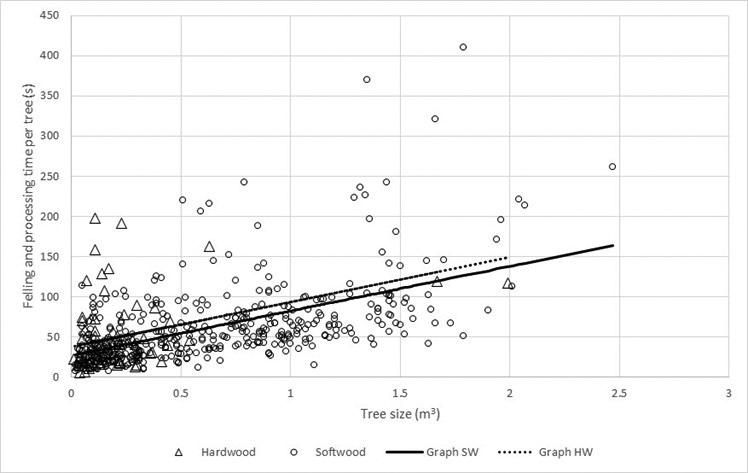
Fig. 1. Ponsse Ergo harvester cycle time (s tree–1) as a function of tree volume (m3) for both hardwood and softwood species.
Loads were forwarded by the Ponsse Elephant over a range of distances varying from 200 to 1200 m. Median extraction distance was 622 m, and the median cycle time was around 40 minutes (Table 6). Median load size approached 17 m3 and productivity exceeded 25 m3 pmh–1. Terrain hindrance resulted in a low travel speed, estimated at 4.0 km h–1 and 4.5 km h–1 for the unloaded outhaul trip and the loaded inhaul trip, respectively. That difference was significant at the 5% level. The slower empty speed was likely the result of careful path selection and load search given the wet and challenging conditions. Hot loading onto a truck bay took approximately 55% more time than cold loading onto a deck (p < 0.05).
| Table 6. Key performance indicators for the Ponsse Elephant forwarder. | ||||
| Variable | Unit | Mean | SD | Median |
| Outhaul | s | 552 | 151 | 532 |
| Load | s | 793 | 289 | 727 |
| Move | s | 206 | 179 | 119 |
| Inhaul | s | 486 | 151 | 511 |
| Unload onto deck | s | 337 | 130 | 298 |
| Unload onto truck | s | 523 | 134 | 485 |
| Distance | m | 631 | 223 | 622 |
| Logs | n° | 54 | 9 | 52 |
| Stops | n° | 4.6 | 1.9 | 4.0 |
| Load | m3 | 17.1 | 2.9 | 16.6 |
| Productivity | m3 pmh–1 | 25.7 | 6.1 | 26.8 |
| Outhaul | s m–1 | 0.88 | 0.22 | 0.90 |
| Inhaul | s m–1 | 0.76 | 0.28 | 0.79 |
| SD = Standard deviation; pmh = productive machine hours (excluding delays); m3 = cubic meters over bark. | ||||
Truck loads varied from 26 to 31 m3. Loading took between 15 and 22 minutes per truck – excluding all waiting time. Hot loading took 30% less time than cold loading, for the same forwarder and operator and that difference was statistically significant (p = 0.0233) (Table 7). Loading the front bunk was 10% faster than loading the rear bunk, for the same truck, forwarder, and operator (p = 0.0148).
| Table 7. Key performance indicators for loading with the Ponsse Elephant forwarder. | |||||||||
| Variable | Hot deck n = 14 | Cold deck n = 3 | |||||||
| Mean | SD | Median | Mean | SD | Median | p-value | |||
| Load | log n° | 88 | 13 | 90 | 85 | 9 | 88 | 0.5700 | |
| Load | m3 | 27.8 | 1.8 | 27.5 | 28.9 | 2.9 | 29.7 | 0.6143 | |
| Loading time | s | 949 | 208 | 928 | 1330 | 42 | 1332 | 0.0233 | |
| Grapple loads | n° | 24 | 3 | 23 | 24 | 3 | 24 | 0.7984 | |
| Productivity | m3 pmh–1 | 109.8 | 22.8 | 111.4 | 78.1 | 5.6 | 80.4 | 0.0233 | |
| Front n = 17 | Rear n = 17 | ||||||||
| Mean | SD | Median | Mean | SD | Median | p-value | |||
| Load | log n° | 43 | 7 | 44 | 44 | 7 | 46 | 0.9241 | |
| Load | m3 | 13.9 | 1.5 | 13.9 | 14.1 | 1.3 | 14.3 | 0.7946 | |
| Loading time | s | 470 | 131 | 477 | 546 | 135 | 523 | 0.0148 | |
| Grapple loads | n° | 11 | 2 | 11 | 12 | 2 | 12 | 0.1664 | |
| Productivity | m3 pmh–1 | 114.2 | 33.6 | 104.0 | 98.3 | 26.0 | 99.2 | 0.0759 | |
| SD = Standard deviation; pmh = productive machine hours (excluding delays); m3 = cubic meters over bark; p-value returned by the non-parametric Mann-Whitney U-test. | |||||||||
Harvester productivity averaged 38.4 m3 pmh–1, excluding delays, while the forwarder produced an average of 20.7 m3 pmh–1 after accounting for the time spent loading trucks (Table 8). Overall system productivity averaged 14.5 m3 smh–1. System productivity was constrained by the productivity of the forwarder because of system and market constraints, such as the requirement to deliver timber within a few days of felling, meaning that the harvester could not work very far ahead of the forwarder. As a result, the harvester operator typically ceased operations early or performed other tasks when two or more days’ worth of timber had been felled and processed.
| Table 8. Individual machine and harvesting system productivity and cost of the observed system and two alternative scenarios. | |||
| Machine | Harvester | Forwarder | System |
| Loading by forwarder | |||
| Delay-free function productivity (m3 pmh–1) | 38.4 | 20.7 | |
| System productivity (m3 smh–1) | 14.5 | ||
| System onboard truck cost ($ m–3) | -- | $15.91 | |
| System cut-and-haul cost ($ m–3) | -- | $23.93 | |
| Loading by tracked loader | |||
| Delay-free function productivity (m3 pmh–1) | 38.4 | 25.9 | |
| System productivity (m3 smh–1) | 22.2 | ||
| System onboard truck cost ($ m–3) | $14.20 | ||
| System cut-and-haul cost ($ m–3) | $22.21 | ||
| Loading setout trailers with forwarder | |||
| Delay-free function productivity (m3 pmh–1) | 38.4 | 24.0 | |
| System productivity (m3 smh–1) | 19.2 | ||
| System onboard truck cost ($ m–3) | $12.99 | ||
| System cut-and-haul cost ($ m–3) | $21.00 | ||
| pmh = productive machine hours (excluding delays); smh = scheduled machine hours (including delays); m3 = cubic meters over bark. | |||
Onboard truck (excluding transportation) costs averaged $15.91 m–3 and cut-and-haul costs averaged $23.93 m–3 (Table 8). Hauling was the largest component of cut-and-haul costs at $8.02 m–3, followed by felling-processing ($7.73 m–3), extraction ($7.47 m–3), support ($0.35 m–3), and moving to the site ($0.36 m–3). Adding a mobile tracked loader for the task of loading log trucks would increase overall system productivity by an estimated 53% allowing the forwarder to eliminate delays associated with loading trucks. This change would reduce onboard truck costs by an estimated $1.71 m–3, which would amount to an 11% reduction. As an alternative, adding setout trailers to be loaded directly by the forwarder would increase overall system productivity by an estimated 32% and reduce onboard truck costs by $2.92 m–3 (18% reduction).
4 Discussion
The effect of tree size on harvester productivity was evident in this study and has been documented in previous CTL studies in the region (Holtzscher and Lanford 1997; Tufts 1997; Bolding and Lanford 2005) and globally (Di Fulvio et al. 2024). This effect was especially pronounced in the differences between softwood and hardwood species. Hardwood stems were characterized by significantly more challenging form as documented by other studies outlining the production handicap derived from the poor form of hardwood trees (LeDoux and Huyler 2001; Labelle et al. 2016). Hence, we maintained the indicator variable for hardwoods in the regression equation even if that was only significant at the 6% level, not at the 5% level (Table 5). Borderline significance may result from the relatively small number of hardwood trees in the sample and from them being concentrated in the smaller size range. Therefore, data imbalance confounded the results and prevented the analysis from returning more reliable results.
The relative inexperience of the machine operators led to challenges due to a lack of oversight and inconsistency in operations often stemming from infrequent communication between harvester and forwarder operators. Also, operators were not utilizing onboard GPS mapping systems which further contributed to inefficiencies. Management, training, and communication are especially important for proficiency when using complex CTL systems, specifically harvesters (Purfürst 2010). In addition, the challenges related to wet soil conditions such as difficult trafficability, partially sunken logs, poor visibility, and difficulties determining log sorts made communication, experience, and harvest planning even more important. Unfortunately, due to the lack of sustained use of CTL systems in the US South and the absence of formal training programs, it is quite hard to find operators and managers who possess specific expertise (Bolding et al. 2025). These challenges, along with the effect of scattered logs influencing the number of loading stops, contributed to slower than expected forwarder travel speeds and low overall productivity when compared with other studies evaluating CTL systems in normal forest conditions (Tufts 1997; Proto et al. 2018; Ferreira et al. 2025). However, our results were similar when compared to studies evaluating forwarding in challenging terrain conditions (Tiernan et al. 2004). Further, our results are quite promising compared to findings from a large benchmarking study conducted in northern Sweden (Eriksson and Lindroos 2014) that reported average harvester and forwarder productivity in the region of 23.8 m3 pmh–1 and 21.4 m3 pmh–1, respectively.
Results suggest that CTL can be cost-competitive on sites that are too wet and/or too small to productively harvest with conventional FT systems, but not so wet that CTL would cause unacceptable soil disturbance. Overall system productivity (14.5 m3 smh–1 or 578 m3 wk–1) was 44% that of typical FT systems used in the region, while onboard truck costs ($15.91 m–3) were 13% higher than published logging rates in the region (Table 8, Conrad et al. 2024). Given the challenging conditions, these results are encouraging for the use of CTL on these sites. Adding a tracked loader to the system would increase weekly productivity to an estimated 882 m3 (32 loads), 66% of the regional average. Likewise, onboard truck costs could be reduced to an estimated $14.20 m–3 and $12.99 m–3 with the use of a tracked loader and setout trailers, respectively. Onboard truck costs were $0.16 m–3 higher and $1.05 m–3 lower than market logging rates for non-swamp applications using a tracked loader and setout trailers, respectively (TimberMart-South 2025). Lower productivity and higher costs per unit volume discourage logging businesses in the US South from adopting the CTL system (Bolding et al. 2025). It is important to note that our harvesting cost estimates include costs only and do not account for profit or risk allowance, so a logger should seek a higher logging rate than our cost estimates.
5 Conclusions
This study provides information on the use of CTL systems when harvesting small, wet sites in the US South. The benefits of the CTL design features were evident as the harvester was able to maximize value recovery through computer-aided bucking in large, valuable, softwood stems that can be challenging or impossible to harvest cost effectively with FT systems. While the harvester’s productivity was largely affected by tree size and type, forwarder productivity impacts were affected by terrain conditions and operational factors. All machine operators were relatively inexperienced and had received no formal operator training, as is common in the region for both FT and CTL systems. Forwarder productivity was reduced by wet site conditions that resulted in difficult trafficability, sunken logs, and log piles that were difficult to see from the cab of the forwarder. These conditions would have been difficult, even for experienced operators. Some of these impacts could be mitigated through careful attention to harvest planning, management oversight and coordination, and better communication between the harvester and forwarder operators. Utilizing machine tracking software could shorten forwarder cycle times by reducing time spent searching for log piles processed by the harvester. Harvesters also have the capability of denoting log product classes with paint, which would reduce misclassifications by the forwarder operator.
Another major impediment to CTL system success in the US South is the integration of the CTL “cold logging” system into a predominantly “hot logging” supply chain. The typical FT scenario involves little in-processing inventory where log trucks are loaded upon arrival to an active harvest site by a loader with stems that were recently processed. This hot loading requirement does not work well with the design of the CTL system that benefits from machines working independently, therefore maximizing utilization and minimizing interaction delays. Hot loading via forwarder requires the machine to load log trucks from its bunk as well as from cold decks, which limits forwarding productivity. Our data and alternative scenario evaluation suggests that decoupling forwarding from hot loading trucks by either 1) employing a dedicated tracked loader to load trucks from cold decks, or 2) off-loading from the forwarder onto setout trailers would improve system productivity and reduce costs. Both alternatives are superior to the approach evaluated and would allow the forwarder to maximize its utility and productivity, by focusing on the extraction function in the difficult terrain conditions, as the machine was designed. With operational modifications and improved harvest planning and communication, the CTL system can fill an important niche and be cost effective on small wet sites in the US South to recover valuable timber that is often underutilized.
Data availability
All data from this study are openly available in University of Georgia Open Scholar, https://openscholar.uga.edu/record/27985.
Authors contribution
MCB, JLC, NM, RS: conceptualization, methodology, data collection, investigation, writing-original draft; JLC: cost analysis, visualization, text review and commentary; NM, RS: productivity analysis, visualization, text review and commentary; MCB: funding acquisition, project administration, compiling complete draft, visualization; TM: project partner coordination, data collection, data curation, text review and commentary.
Acknowledgments
The authors acknowledge Miller Timber Services, Inc. and Rayonier, Inc. for providing field sites, coordinating harvesting activities, and collaborating with the research team. Further, we acknowledge Ms. Hasini Mapatunage for her assistance with data collection. The use of brand or model names is for reader convenience only and does not constitute an endorsement by the authors, the University of Georgia, or Consiglio Nazionale delle Ricerche.
Funding
This work was supported by the Harley Langdale Jr. Center for Forest Business at the University of Georgia, Athens, GA, USA.
References
Adebayo A, Han H, Johnson L (2007) Productivity and cost of cut-to-length and whole-tree harvesting in a mixed-conifer stand. For Prod J 57: 59–69.
Aust WM, Bolding MC, Barrett SM (2020) Silviculture in forested wetlands: summary of current forest operations, potential effects, and long-term experiments. Wetlands 40: 21–36. https://doi.org/10.1007/s13157-019-01191-6.
Bailey M, Crawley A (2023) The economic contribution of logging and trucking in Maine. Economic Development Administration Center, University of Maine, Orono, ME, Staff Paper 109. https://maineloggers.com/wp-content/uploads/2023/02/Logging-and-Trucking-Impact-02.01.23-1.pdf. Accessed 12 May 2025.
Barrett SM, Bolding MC, Munsell JF (2017) Characteristics of logging businesses across Virginia’s diverse physiographic regions. Forests 8, article id 468. https://www.doi.org/10.3390/f8120468.
Björheden R, Thompson M (1995) An international nomenclature for forest work study. In: Field DB (ed) Proceedings of IUFRO 20th World Congress, Caring for the Forest: Research in a Changing World, 1995 August 6–12; Tampere, Finland, pp 190–215.
Black TM, Bolding MC, Conrad JL IV (2025) Updating the machine rate costing approach for forest harvesting machines in the southeastern United States. Int J For Eng 36: 213–221. https://doi.org/10.1080/14942119.2025.2469202.
Board of Governors of the Federal Reserve System (2025) Market yield on U.S. treasury securities at 5-year constant maturity, quoted on an investment basis. https://fred.stlouisfed.org/series/GS5. Accessed 23 May 2025.
Bolding MC, Lanford BL (2005) Wildfire fuel harvesting and resultant biomass utilization using a cut-to-length/small chipper system. For Prod J 55: 181–189.
Bolding MC, Conrad JL IV, Eliasson L, Spinelli R, Magagnotti N, Miller TR, Mapatunage H (2025) The evolution and expansion of cut-to-length harvesting systems beyond Scandinavia: challenges and opportunities in central and southern Europe and North America. Curr For Rep 11, article id 24. https://doi.org/10.1007/s40725-025-00256-6.
Boston K, Murphy GE (2003) Value recovery from two mechanized bucking operation in the southeastern United States. South J Appl For 27: 259–263. https://doi.org/10.1093/sjaf/27.4.259.
Brinker RW, Kinard J, Rummer B, Lanford BL (2002) Machine rates for selected harvesting machines. Alabama Agricultural Experiment Station, Auburn University, Auburn, AL, USA, Circular 296 (revised).
Bureau of Labor Statistics (2025) Occupational employment and wage statistics. https://data.bls.gov/oes/#/area/1300000. Accessed 23 May 2025.
Conrad JL IV, Greene WD, Hiesl P (2024) Georgia and Florida logging businesses persevere through pandemic, rising costs, and uncertainty. For Sci 70: 47–56. https://www.doi.org/10.1093/forsci/fxad050.
Conradie IP (2003) Cut-to-length harvesting systems in the southeastern USA: value recovery and adoption by potential users. MSc thesis. University of Georgia.
Conradie IP, Greene WD, Murphy GE (2004) Value recovery with harvesters in southeastern U.S. pine stands. For Prod J 54: 80–84.
Derochers JE, Conrad JL IV, Bolding MC, da Silva BK, Smidt MF (In review) Ownership and operation of log trucks in the US South: characteristics, costs, and common business strategies. Manuscript.
Di Fulvio F, Acuna M, Ackerman P, Ackerman S, Spinelli R, Abbas D, Kaakkurivaara N, Sánchez-García S, Guerra SPS (2024) Benchmarking operational conditions, productivity, and costs of harvesting from industrial plantations in different global regions. Int J For Eng 35: 225–250. https://doi.org/10.1080/14942119.2023.2296789.
Energy Information Administration (EIA) (2025) Gasoline and diesel price update. https://www.eia.gov/petroleum/gasdiesel/. Accessed 23 May 2025.
Erber G, Holzleitner F, Kastner M, Stampfer K (2016) Effect of multi tree handling and tree-size on harvester performance in small diameter hardwood thinnings. Silva Fenn 50, article id 1428. https://doi.org/10.14214/sf.1428.
Eriksson M, Lindroos O (2014) Productivity of harvesters and forwarders in CTL operations in northern Sweden based on large follow-up datasets. Int J For Eng 25: 179–200. https://doi.org/10.1080/14942119.2014.974309.
Erler J, Duka A, Papa I, Bade C, Borz SA, Lindroos O, Lundbäck M, Mederski PS, Bembenek M, Mionetto N, Maganotti N, Simonetti M, Stampfer K, Pavelić N, Spinelli R (2024) Technodiversity – glossary of forest operations terms. Croat J For Eng 45: 393–401. https://www.doi.org/10.5552/crojfe.2024.2364.
Ferreira F, Freitas L, Leite E, Silva M, Santos S, Simões D, Fiedler N, Silva L, Rocabado J, do Carmo F, Souza J (2025) Forwarder machine performance in eucalyptus forests in Brazil with different productivity levels: an analysis of production costs. Forests 16, article id 646. https://doi.org/10.3390/f16040646.
Fulvio D, Acuna M, Ackerman P, Ackerman S, Spinelli R, Abbas D, Kaakkurivaara N, Sánchez-García S, Guerra S (2024) Benchmarking operational conditions, productivity, and costs of harvesting from industrial plantations in different global regions. Int J For Eng 35: 225–250. https://doi.org/10.1080/14942119.2023.2296789.
Georgia Department of Revenue (GA DOR) (2025) Calculating tax on motor fuel. https://dor.georgia.gov/taxes/motor-fuel-tax/calculating-tax-motor-fuel. Accessed 23 May 2025.
Gerow Jr T, Lang AJ (2022) Shovel logging recommendations added to North Carolina’s forestry BMP manual. Forest Resources Association, Washington DC, USA, Technical Release 22-R-14.
Ghaffariyan MR (2014) A short review of efficient ground-based harvesting systems for steep and mountainous areas. Bull Transilv Univ Bras 7: 11–16.
Gingras J-F (2004) Early studies of multi-tree handling in Eastern Canada. Int J For Eng 15:18–22. https://doi.org/10.1080/14942119.2004.10702493.
Han HS, Kellogg L (2000) Damage characteristics in young Douglas-fir stands from commercial thinning with four timber harvesting systems. West J Appl For 15: 27–33. https://doi.org/10.1093/wjaf/15.1.27.
Harstela P (1999) The future of timber harvesting in Finland. J For Eng 10: 33–36.
Holtzscher MA, Lanford BL (1997) Tree diameter effects on cost and productivity of cut-to-length systems. For Prod J 47: 25–30.
Jacobson S, Kukkola M, Mälkönen E, Tveite B (2000) Impact of whole-tree harvesting and compensatory fertilization on growth of coniferous thinning stands. For Ecol Manag 129: 41–51. https://doi.org/10.1016/S0378-1127(99)00159-0.
Kammenga J (1983) Whole-tree utilization system for thinning young Douglas-fir. J For 4: 220–224. https://doi.org/10.1093/jof/81.4.220.
Kellogg LD, Bettinger P (1994) Thinning productivity and cost for a mechanized cut-to-length system in the Northwest Pacific Coast Region of the USA. J For Eng 5: 43–54. https://doi.org/10.1080/08435243.1994.10702659.
Khadka S, Hiesl P, Timilsina N, Hagan DL, Conrad JL IV (2025) The state of logging businesses in North and South Carolina in 2022. Int J For Eng 36: 273–286. https://www.doi.org/10.1080/14942119.2025.2469200.
Kittredge Jr DB, Mauri MJ, McGuire EJ (1996) Decreasing woodlot size and the future of timber sales in Massachusetts: when is an operation too small? North J Appl For 13: 96–101. https://doi.org/10.1093/njaf/13.2.96.
Koŝir B (2008) Modelling stand damage and comparison of two harvesting methods. Croat J For Eng 29: 5–14.
Internal Revenue Service (IRS) (2025) Standard mileage rates. https://www.irs.gov/tax-professionals/standard-mileage-rates. Accessed 23 May 2025.
Labelle ER, Soucy M, Cyr A, Pelletier G (2016) Effect of tree form on the productivity of a cut-to-length harvester in a hardwood dominated stand. Croat J For Eng 37: 175–183.
Lanford BL (1982) Application of a small forwarder in plantation thinning. South J Appl For 6: 183–188. https://doi.org/10.1093/sjaf/6.4.183.
Lanford BL, Stokes BJ (1995) Comparison of two thinning systems. Part 1: stand and site impacts. For Prod J 45:74–79.
LeDoux CB, Huyler NK (2001) Comparison of two cut-to-length harvesting systems operating in eastern hardwoods. J For Eng 12: 53–60.
Lindroos O, La Hera P, Häggström C (2017) Drivers of advances in mechanized timber harvesting – a selective review of technological innovation. Croat J For Eng 38: 243–258.
Lundbäck M, Häggström C, Nordfjell T (2021) Worldwide trends in methods for harvesting and extracting industrial roundwood. Int J For Eng 32(3): 202–215. https://doi.org/10.1080/14942119.2021.1906617.
Magagnotti N, Kanzian C, Schulmeyer F, Spinelli R (2013) A new guide for work studies in forestry. Int J For Eng 24: 249–253. https://doi.org/10.1080/14942119.2013.856613.
Magagnotti N, Spinelli R, Kärhä K, Mederski P (2021) Multi-tree cut-to-length harvesting of short-rotation poplar plantations. Eur J For Res 140: 345–354. https://doi.org/10.1007/s10342-020-01335-y.
McDonald TP, Seixas F (1997) Effect of slash on forwarder soil compaction. J For Eng 8: 15–26. https://doi.org/10.1080/08435243.1997.10702700.
Miyata ES (1980) Determining fixed and operating costs of logging equipment. USDA Forest Service, St. Paul, MN USA, General Technical Report NC-55.
Moldenhauer MC, Bolding MC (2009) Parcelization of South Carolina’s private forestland: loggers’ reactions to a growing threat. For Prod J 59: 37–43.
Nord-Larsen T (2002) Stand and site productivity response following whole-tree harvesting in early thinnings of Norway spruce (Picea abies (L.) Karst.). Biomass Bioenergy 23: 1–12. https://doi.org/10.1016/S0961-9534(02)00032-6.
Olsen ED, Kellogg LD (1983) Comparison of time-study techniques for evaluating logging production. Trans ASAE 26: 1665–1669. https://doi.org/10.13031/2013.33821.
Pimentel D, Wilson C, McCullum C, Huang R, Dwen P, Flack J, Tran Q, Saltman T, Cliff B (1997) Economic and environmental benefits of biodiversity. BioSci 47: 747–757. https://doi.org/10.2307/1313097.
Proto AR, Macrì G, Visser R, Harrill H, Russo D, Zimbalatti G (2018) Factors affecting forwarder productivity. Eur J For Res 137: 143–151. https://doi.org/10.1007/s10342-017-1088-6.
Purfürst F (2010) Learning curves of harvester operators. Croat J Eng 31: 89–97.
Roberge ME, Van Dick R (2010) Recognizing the benefits of diversity: when and how does diversity increase group performance? Hum Res Manag Rev 20: 295–308. https://doi.org/10.1016/j.hrmr.2009.09.002.
Shivan GC, Potter-Witter K, Blinn CR, Rickenbach M (2020) The logging sector in the Lake States of Michigan, Minnesota, and Wisconsin: status, issues, and opportunities. J For 118: 501–514. https://doi.org/10.1093/jofore/fvaa021.
Sirén M, Salmivaara A, Ala-llomäki J, Launiainen S, Lindeman H, Uusitalo J, Sutinen R, Hänninen P (2019) Predicting forwarder rut formation on fine-grained mineral soils. Scan J For Res 34: 145–154. https://doi.org/10.1080/02827581.2018.1562567.
Smolander A, Kitunen V, Tamminen P, Kukkola M (2010) Removal of logging residue in Norway spruce thinning stands: long-term changes in organic layer properties. Soil Bio Biochem 42: 1222–1228. https://doi.org/10.1016/j.soilbio.2010.04.015.
Spinelli R, Visser R (2008) Analyzing and estimating delays in harvester operations. Int J For Eng 19: 35–40. https://doi.org/10.1080/14942119.2008.10702558.
Spinelli R, Owende P, Ward S (2009) A harvest and transport cost model for Eucalyptus spp. fast-growing short rotation plantations. Biomass Bioenergy 33: 1265–1270. https://doi.org/10.1016/j.biombioe.2009.05.010.
Stokes BJ, Schilling A (1997) Improved harvesting systems for wet sites. For Ecol Manag 90: 155–160. https://doi.org/10.1016/S0378-1127(96)03907-2.
Tiernan D, Zeleke G, Owende PM, Kanali C, Lyons J, Ward S (2004) Effect of working conditions on forwarder productivity in cut-to-length timber harvesting on sensitive forest sites in Ireland. Biosyst Eng 87: 167–177. https://doi.org/10.1016/j.biosystemseng.2003.11.009.
TimberMart-South (2025) Biomass, logging rates, and species detail: 1st quarter 2025. Norris Foundation, Athens, GA, USA.
Tufts RA (1997) Productivity and cost of the Ponsse 15-series, cut-to-length harvesting system in Southern pine plantations. For Prod J 47: 39–46.
Tufts RA, Lanford BL, Greene WD, Burrows JO (1985) Auburn harvesting analyzer. Compiler 3: 14–15.
USDA NRCS (2025) Web Soil Survey. USDA Natural Resource Conservation Service. https://www.nrcs.usda.gov/resources/data-and-reports/web-soil-survey. Accessed 23 December 2025.
Viceira L, Wang Z (2018) Global portfolio diversification for long-horizon investors. Harvard Business School Working Paper 17-085.
Visser R, Stampfer K (2003) Tree-length system evaluation of second thinning in a loblolly pine plantation. South J Appl For 27: 77–82. https://doi.org/10.1093/sjaf/27.2.77.
Zhang F, Johnson DM, Wang J, Yu C (2016) Cost, energy use and ghg emissions for forest biomass harvesting operations. Energy 114: 1053–1062. https://doi:10.1016/j.energy.2016.07.086.
Total of 68 references.

